Key takeaways
- Roofs, terraces and balconies need a continuous membrane, correct falls and protected junctions.
- Heat cycles stress waterproofing, so membranes should be UV-stable or covered with a protective layer.
- Most leaks start at joints, drains and wall upstands, not in the open field.
- Test before covering: flood-test terraces and photograph the membrane.
A durable roof or terrace in Dubai needs a continuous waterproofing membrane, correct falls to drains, sealed junctions and a protective layer against UV and heat. Rain is rare, which is why defects stay hidden until the first storm — and then show up as stains on a neighbour's ceiling.
Where leaks actually start
- Wall-to-floor junctions and upstands
- Around drains, pipes and AC supports
- Expansion and movement joints
- Cracks in screed or concrete
- Sealants that have hardened and split under the sun
Roofs
A typical roof build-up includes a sloped screed or insulation, a waterproofing membrane, a protection layer and a finish. Thermal insulation also reduces cooling load, so waterproofing and energy performance are best handled in one project. Roof drains should be sized and kept clear; a blocked outlet can pond water for days.
Terraces and balconies
Terraces are walked on, furnished and irrigated, so the membrane must be protected. We detail:
- Falls of at least a consistent slope towards drains
- Membrane continuous across the floor and turned up walls
- Reinforcement at corners, pipes and joints
- Flood test for 24–48 hours before covering
- Protection and finish: screed, tiles or timber decking on pedestals
Raised decking and large porcelain pavers on pedestals keep water flowing beneath and make future access easy.
Repair or replace?
A survey checks adhesion, blisters, ponding and drainage. Local failures can be repaired and recoated; widespread de-bonding or old, brittle membranes usually justify replacement. Moisture meters and thermal imaging help find wet insulation without opening everything.
Planters, pools and wet areas
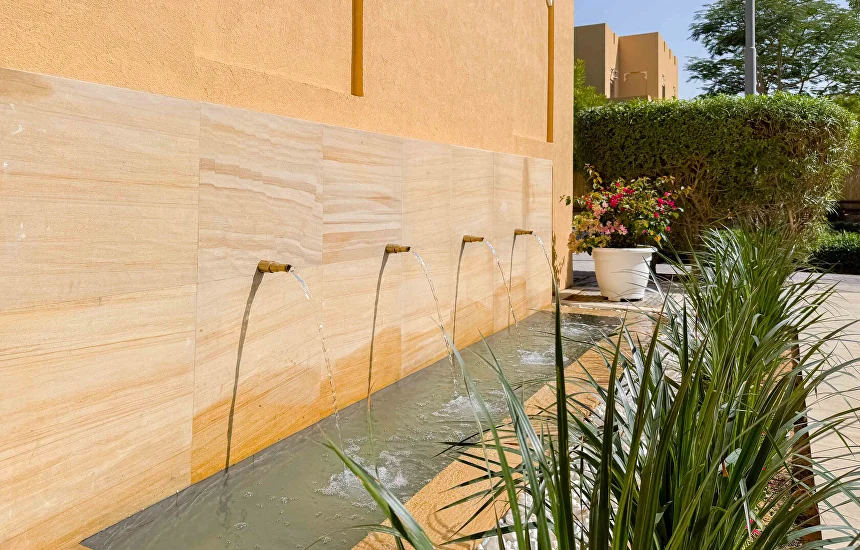
Raised planters, water features and plant rooms need their own waterproofing and drainage. Treat them like small bathrooms — see our bathroom waterproofing guide.
Mistakes to avoid
- Waterproofing over dirty, damp or poorly prepared surfaces
- No upstand at walls and thresholds
- Skipping the flood test
- Drilling through the membrane afterwards without resealing
Waterproofing sits within our turnkey renovation scope, so surveys, repairs and finishes are delivered by one team.
FAQ
Why do roofs and terraces leak in Dubai when it rarely rains?
Heavy, short downpours overwhelm blocked drains, while daily heat cycles crack ageing membranes and sealants. Irrigation, AC condensate and pressure-washing also add water throughout the year.
What is the best waterproofing for a terrace?
A continuous liquid-applied or sheet membrane with reinforced junctions, protected by screed and tiles or a UV-stable topcoat, is common. The right system depends on substrate, use and finish.
Can a leaking roof be repaired without replacing everything?
Often yes if the membrane is sound elsewhere: localised repairs at drains, joints and upstands, plus a new protective coating. A survey shows whether partial repair or full replacement is sensible.